Monographs // Articles
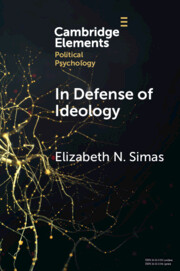
In Defense of Ideology: Reexamining the Role of Ideology in the American Electorate
Years of collective political science research has fueled the stereotype of the uninformed or illogical American voter who ardently supports parties or candidates but lacks any cohesive ideological reasons for doing so. Using a variety of more contemporary survey and experimental data, it shows that a substantial portion of Americans do hold coherent political beliefs and that these beliefs have important consequences for the American political system. I focus on three major claims: (1) the percentage of individuals with coherently connected political beliefs is larger than is often assumed; (2) for many, these policy beliefs are an important part of the way they think about ideological labels; and (3) these policy beliefs have important effects on political behavior that should not just be attributed to identity. The ultimate conclusion is that when thinking about the various ways in which an individual may be ideological, members of the American public fit these definitions a good deal more than they are typically given credit for.
Peer-Reviewed Journal Articles
- Elizabeth Simas. Accepted. “It’s Not Me, It’s You? Reexamining How Perceived Sexism Impacts Candidate Electability.” Politics, Groups, and Identities.
- Scott Clifford, Elizabeth Simas, and JeongKyu Suh.* Accepted. “The Policy Basis of Group Sentiments.” Political Science Research and Methods.
- Scott Clifford and Elizabeth Simas. 2024. “Moral Rhetoric, Extreme Positions, and Perceptions of Candidate Sincerity.” Political Behavior, 46(1): 523-542.
- Justin Kirkland, Elizabeth Simas, and Scott Clifford. 2024. “Perceptions of Party Incongruence and the Formation of Political Ambition.” Political Behavior, 46(1): 257-276.
- Jamie Wright,* Scott Clifford, and Elizabeth Simas. 2022. “The Limits of Issue Ownership in a Polarized Era.” American Politics Research, 50(5): 694-706.
- Elizabeth Simas. 2022. “But Can She Make America Great Again: Threat, Stability, and Candidate Sex in U.S. Elections.” Political Behavior, 44(1): 1-21.
- Alex Badas and Elizabeth Simas. 2022. “The Supreme Court as an Electoral Issue: Evidence from Three Studies.” Political Science Research and Methods, 10(1): 49-67. *WINNER: Best Journal Article Award, APSA Law and Courts Section*
- Elizabeth Simas and Adam Ozer*. 2021. “Polarization, Candidate Positioning, and Political Participation in the U.S.” Electoral Studies, 73(102370).
- Scott Clifford, Elizabeth Simas, and Justin Kirkland. 2021. “Do Elections Keep the Compassionate out of the Candidate Pool?” Public Opinion Quarterly, 85(2): 649-662
- Elizabeth Simas, Kerri Milita, and John Barry Ryan. 2021. “Ambiguous Rhetoric and Legislative Accountability.” Journal of Politics, 83(4): 1695-1705
- Elizabeth Simas. 2021. “Medicare for All, Some, or None?: Testing the Effects of Ambiguity in the Context of the 2020 Presidential Election.” PS: Political Science & Politics, 54(2): 208-213.
- Elizabeth Simas. 2020. “An Extremely High Quality Candidate?: Ideological Positioning and Perceptions of Candidate Competence and Integrity.” Public Opinion Quarterly, 84(3): 699-724.
- Elizabeth Simas, Scott Clifford, and Justin Kirkland. 2020. “How Empathic Concern Fuels Political Polarization.” American Political Science Review, 114(1): 258-269.
- Elizabeth Simas and Doug Murdoch.* 2019. “’I Didn’t Lie, I Misspoke’: Voters’ Responses to Questionable Campaign Statements.” Journal of Experimental Political Science, 7(2): 75-88.
- Scott Clifford, Justin Kirkland, and Elizabeth Simas. 2019. “How Dispositional Empathy Influences Political Ambition.” Journal of Politics, 81(3): 1043-1056.
- Elizabeth Simas. 2018. “Perceptions of the Heterogeneity of Party Elites in the United States.” Party Politics, 24(4): 444-454.
- Elizabeth Simas. 2018 “Ideology through the Partisan Lens: Applying Anchoring Vignettes to U.S. Survey Research.” International Journal of Public Opinion Research, 30(3): 343-364
- Elizabeth Simas and Marcia Bumgardner.* 2017. “Modern Sexism and the 2012 U.S. Presidential Election: Reassessing the Casualties of the ‘War on Women.’” Politics & Gender, 13(3): 359-378.
- Elizabeth Simas. 2017. “The Effects of Electability on U.S. Primary Voters.” Journal of Elections, Public Opinion, and Parties, 27(3): 274-290.
- Elizabeth Simas and Adam Ozer.* 2017. “Church or State?: Reassessing How Religion Shapes Perceptions Candidate Positions.” Research & Politics, 4(2).
- Kerri Milita, Elizabeth Simas, John Ryan, and Yanna Krupnikov. 2017. “The Effects of Ambiguous Rhetoric in Congressional Elections.” Electoral Studies, 46(1): 48-63.
- John Ryan, Kerri Milita, and Elizabeth Simas. 2014. “Nothing to Hide, Nowhere to Run, or Nothing to Lose: Candidate Position-Taking in Congressional Elections.” Political Behavior, 36(2): 427-449.
- Elizabeth Simas. 2013. “Proximity Voting in the 2010 U.S. House Elections.” Electoral Studies, 32(4): 708-717
- Cindy Kam and Elizabeth Simas. 2012. “Risk Attitudes, Candidate Characteristics, and Vote Choice.” Public Opinion Quarterly, 76(4): 747-760
- Elizabeth Simas and Kevin Evans. 2011. “Linking Party Platforms to Perceptions of Presidential Candidates’ Policy Positions, 1972-1996.” Political Research Quarterly, 64(4): 831-839
- James Adams, Samuel Merrill, Elizabeth Simas, and Walter Stone. 2011.“When Candidates Value Good Character: A Spatial Model with Applications to Congressional Elections.” Journal of Politics, 73(1): 17-30.
- Cindy Kam and Elizabeth Simas. 2010. “Risk Orientations and Policy Frames.” Journal of Politics, 72(2): 381-396.
- Walter Stone and Elizabeth Simas. 2010. “Candidate Valence and Ideological Positions in U.S. House Elections.” American Journal of Political Science, 54(2): 371-388
 Elizabeth N. Simas